
25th March 2026
From productivity to financial resilience
Scott Sampson, executive director, health and care, Civica
‘Building an NHS fit for the future’ is one of the government’s key manifesto pledges. This means transformation, but to get there the health service must first overcome two significant challenges of today: the need to increase productivity and to reduce costs.
This double-edged sword is perhaps best highlighted by two specific objectives. The first is around productivity – to return to the NHS constitutional standard that 92% of patients wait less than 18 weeks for elective treatment. The second is about financial resilience and finding ways to reduce the £7bn funding deficit.
Together, in simple terms, it means doing more with less.
Digital-first strategy
To get that balance right, the 10-Year Health Plan for England talks about making shifts from ‘analogue to digital’, from ‘hospital to community’ and from ‘sickness to prevention’.
Achieving the first of these – introducing more digital processes and services – is arguably the gateway to achieving the other two. This is where the hospital can be connected to the community and where patient data can inform proactive health management for every citizen. Reaching this point of digital enablement is the key to unlocking a more efficient and sustainable health service.
So, let’s consider where smart technologies and software solutions can start making inroads today.
Technologies to help achieve NHS targets for waiting times
The last time that the 92% target was attained for patient waiting times was over a decade ago in September 2015. Since then, the percentages have been declining. For the last few years, only about 60% patients receive their pre-planned treatment within 18 weeks.
Increasing hospital activity to work through the backlog of patients waiting for treatment is easier said than done. Research from the Institute of Fiscal Studies suggests that productivity would need to grow by at least 4.9% to reach the target, far higher than we have seen in recent years and at a time when funding is being cut.
One of the biggest barriers to reducing the time it takes from referral to treatment is the inefficiencies found in the IT systems that are supposed to support clinical pathways. Poor interoperability of data, disconnected or siloed systems, inconsistency in data practices and a lack of data maturity are all contributing factors that ultimately mean that information is still not easily shared along a pathway. This, and the fact that around £250 million is still spent on storing and managing paper every year.
Patients are left waiting for slow responses while healthcare providers are frustrated when trying to join up the dots. We can see these disconnects occurring between primary and secondary care, but also with social and community-based care, between different trusts, different hospital departments, and with mental health services.
Helping systems talk to one another
The rollout of electronic patient records (EPR), which now covers almost all NHS Trusts, has proven to be only one part of the solution. To take things further, it’s not necessarily about replacement of systems, but making them interoperable.
Employing technology that can bring data from different systems into a single view, giving access to a complete and up to date health record, enables clinical staff to make better decisions, faster. Use cases include electronic document management, more targeted appointment booking based on an accurate view of the available resourcing, better flagging of patients with additional needs, more consistent case management, better patient engagement or closer management of prescriptions, to pick just a few examples.
By centralising this information and integrating with EPR across all healthcare settings, decision makers gain an enriched data pool that can feed analysis for improving workflows around real-world patient and frontline experiences.
Technology can do this job, and the incremental gains will begin to move the dial on productivity without busting budgets.
Technologies to improve NHS financial resilience
Long term success for the NHS also means breaking free of its funding deficit. In the short term, this means finding ways to reduce spending by a total of £7bn.
We are already seeing cuts and restructuring, such as the dissolution of NHS England and calls to reduce the running costs of integrated care boards by 50%. A survey of trust leaders by NHS Providers found that 37% of trusts are cutting clinical posts and 86% cutting non-clinical posts.
Major structural reform like this means concerns for those whose jobs are under threat and disruption for those tasked with keeping services running. This can have a long-lasting impact on the workforce morale if it’s not managed correctly.
There is a job to keep staff feeling valued and encouraged to deliver their best work. A digitised workforce management system can help to reduce the cost of attrition or disengaged workers by taking a more proactive and automated approach to engaging staff and looking after their professional development and wellbeing.
Data-driven insights for cost management
Besides staff cuts, 47% of trusts are also looking to scale back services including virtual wards, rehabilitation centres and diabetes services for young people. Of course, nobody wants to see any of these cuts and productivity improvements should not be made at the cost of patient outcomes.
Technology-based solutions that help with cost management and better resource deployment offer a way to improve service efficiency by identifying savings that might not otherwise be visible.
This could be using data-driven insights to align capacity with demand, to help reduce agency spend or to model future service demands so that planning can be done with far greater accuracy. These tools are available to minimise wastage and inefficiencies so that budgets can go further.
If you’re leading digital change in your organisation and wondering what comes next, or where technology can deliver constructive and money-saving changes within current systems and processes, we’d love to hear from you.
You may also be interested in
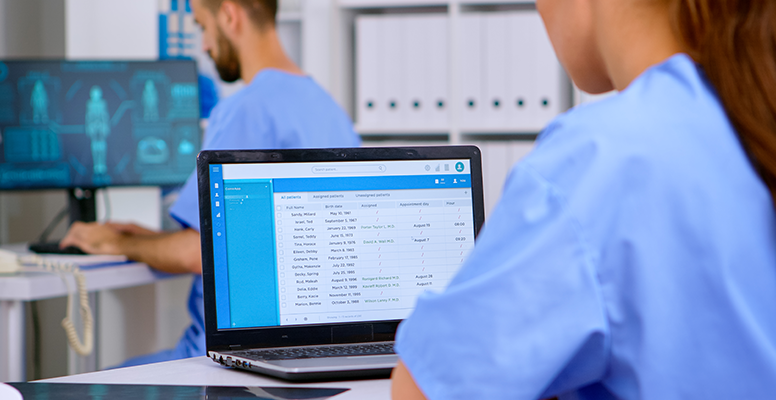
The NHS paper weight: Reaching for a paperless health system
Even in an age of AI and digital health apps, paper still dominates NHS practices. It costs billions every year, slows down staff, and risks patient safety. Digitisation is the bridge to unlock savings, free up resources, and deliver safer patient care.

Interoperability in NHS cancer care: Fixing the digital disconnect
Better system integration and unified patient records can transform NHS cancer pathways, freeing up clinicians to focus on what matters most: delivering life-saving treatment with speed and confidence.

Civica Clinical Pathways
Giving clinicians the data to effectively manage patient pathways and improve care.