
3rd March 2026
Key considerations when combining local government financial systems
Emily Douglin, executive director – local government, Civica
Few areas expose the dual complexity and opportunity of Local Government Reorganisation (LGR) more clearly than the quest for financial systems alignment. There is a real urgency to start planning now. It can look like a lot to handle with challenges around audit maturity, governance and risk alignment, harmonisation of numerous systems, suppliers, T&Cs and more. Yet, handled well, it’s a rare chance to reset and build finance functions that are more transparent, consistent and resilient for the long term.
It’s important to remember that this is a marathon and not a sprint, so here we break down the four critical phases that financial leaders are going to need to work through as they move from the legacy of the old world to the vision for the new.
As the example from Westmorland & Furness Council at the end highlights – a council that is already well advanced in its LGR journey – unification should mean that authorities emerge stronger on the other side with very demonstrable benefits.
1. Continuity
Things won’t all change immediately, but everyone will feel the change.
Most people reading this will remember the infamous millennium bug fears that systems would collapse as the clocks ticked over from 1999 to the year 2000. Council leaders preparing for their vesting day will no doubt carry similar worst case anxieties for making the switch to their new single authority.
In the finance department, keeping the lights on is not just a metaphor for business as usual, it’s a literal consideration for those in charge of paying the bills. In doing so, they are also responsible for making sure that critical services for the most vulnerable in society keep running. The primary objective will be to get to a safe and legal place where financial services continue without disruption. Afterall, revenues still need to be collected, citizens still depend on their benefits, and staff still need to get paid to keep councils operational.
While there will be a roadmap for bigger changes that includes key dates around contracts expiring, applications getting upgraded and services getting aggregated onto new platforms, on day one financial systems will most likely continue to run as before through their local teams to ensure minimal disruption.
The continuity challenge, then, is more around people and assurance at this stage. We can't underestimate the impact of the changes that LGR will bring to workplace culture and the relationship between the employee and their employer. Working through the ambiguity and providing clear instructions and updates around BAU is going to be critical for vesting day. This is where soft skills, people management and good communication come into play.
2. Consolidation
Start by getting the shop in order.
Vesting day will still feel a long way off for those councils aiming to be part of a new authority by 2028 , but planning for consolidation will begin immediately. Council leaders know that whatever shape the new world is going to take, getting the shop in order as early as possible is the best possible strategy.
Joining up financial records means that assets, liabilities, debts, contracts, staff, reserves and financial commitments from multiple entities will all need to be combined or reassigned. If the financial records are weak, the new authority may inherit unknown or unverified liabilities, incomplete provisions or reserves, contested assets, or unclear contractual obligations. In the short to medium term, it will make consolidation more challenging, but it also has the potential to create bigger accounting headaches down the line with costly audit and governance risks.
Unifying data into a parallel operating model is the best remedy here. So, what does this mean?
All councils will currently be operating separately with their own data. There will be details of fixed assets and lease registers, supplier and customer data, investments held and issued, banking arrangements and chart of accounts. It will cover payment terms, debit balances, multi-year contracts, credit agreements, equity and debts and many more data points.
While councils will be working to the same codes of practice, reporting to the same statutory boards and largely providing the same services to the same types of customers, there will also be differences in things like applications and tools, local circumstances, governance arrangements and appetites for risk.
Consolidation must start with basic data housekeeping and then baselining to get everything into plain sight and on the table. This means working to cleanse, archive and standardise data as soon as possible, giving the best chance of like-for-like comparisons and setting up for interoperability later. That’s where a parallel operating model is created and it will serve you well come unification time.
Ultimately, it means authorities and partners working closely together under a clear mandate and towards the same goal to get systems ready to aggregate later.
3. Transition
Managing the balancing act.
Moving to a single system is the next big step that councils will face, and it will possibly be the most challenging. As we’ve mentioned above, day one will be all about being safe and legal, but that can’t go on indefinitely.
From here, it’s a balancing act to keep business running as usual at the same time as putting the roadmap for systems alignment into action; moving from many systems to one, integrating multiple ways of working into single processes and, again, supporting each other through the cultural shift. There will be a lot of work to do around things like contract novation, procurement and supplier consolidation, harmonising governance structures and aligning funding models, to name a few.
There will inevitably be vital skills and knowledge lost too, as staff potentially leave. This must be mitigated early in the planning stage by carefully documenting processes and ensuring that important information is retained for reference even as things keep moving forward at pace.
One of the main causes for concern that I hear when talking with council leaders looking ahead to LGR is that staffing, skills and infrastructure are going to be extremely stretched. My advice to them is ‘don’t go it alone’. It’s a time when partners in the private sector can be extremely helpful, assisting in technology and systems support and bringing in their transformation expertise and experience. It’s a time when everyone in local government will be trying to find their feet all at once, so keeping connected to the wider sector to share best practices and key lessons, especially those walking the same journey, will provide an invaluable support structure.
4. Transformation
Time to get to value.
Ultimately, LGR is more about transformation than transition. While cost pressures grow, local authority finance systems are crying out for support from efficiency-saving technologies. Becoming a modern digital local government must be the goal, but the most transformative changes are going to take time and will probably only be possible once the new authority has had a chance to bed-in.
Having reached a final decision in July 2021 about the geography split for two new unitary authorities in Cumbria, Westmorland and Furnace Council is already ahead in terms of bringing the council services of three former district councils together. Work began in earnest from 1 April 2023 as the new authority looked to combine multiple legacy systems from the former Barrow, Eden and South Lakeland councils. Financial alignment has been critical, and now the benefits are beginning to come to fruition.
A single, cloud-based revenues and benefits system from Civica is now being implemented that will not only streamline operations and improve the citizen experience, tax-payers can expect to save an estimated £3.6 million over the next decade. This is down to having a unified and consistent approach to managing council tax, business rates collections, Housing Benefits and Council Tax Support for more than 116,000 households and 15,000 businesses across the region. Automation is an important part of this too, removing duplication and manual administrative work that will have hamstrung previous systems.
Cllr Andrew Jarvis, Cabinet Member for Finance at Westmorland and Furness Council, said, “This new system means all residents will receive the same high-quality service, wherever they live. It will give us one set of processes, a more flexible workforce, and deliver real efficiency gains through automation and smarter ways of working.”
The project directly supports key priorities in the Westmorland and Furness Council Plan by improving access to financial support, reducing inequality and enabling a customer-centred, digital approach. It’s a great example of what can happen when local government reorganisation moves from transition to transformation.
To learn more about how we can support you throughout the LGR journey, get in touch. Reduce risk, ensure service continuity and unlock new operating models with Civica.
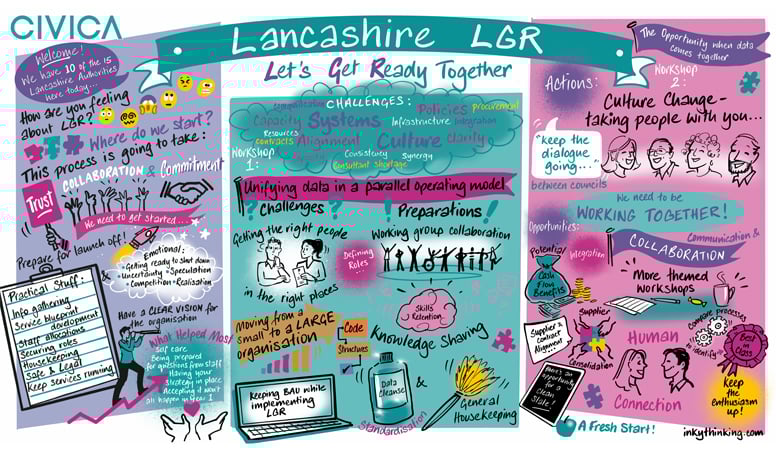
Key themes from a workshop Civica hosted with local authorities from Lancashire to discuss the challenges and opportunities when aligning financial systems as part of LGR.
You may also be interested in
Civica Unifies Revenues and Benefits for Local Authority
Civica to deliver unified Revenues and Benefits system for Westmorland and Furness Council

Rethinking data governance
Are we ready to rip up the rules on data governance?

Civica Revenues & Benefits
Delivering secure revenue collection & ensuring citizens receive the benefits, services and support that they need.